
- Home
- Water Safety Plan
Water Safety Plan
Water Safety Plans & Legionella Management Programs
Protect the people in your building, and your bottom line. Canadian Water Compliance builds custom Water Safety Plans that prevent Legionella and other waterborne hazards before they become an outbreak, a shutdown, or a lawsuit.
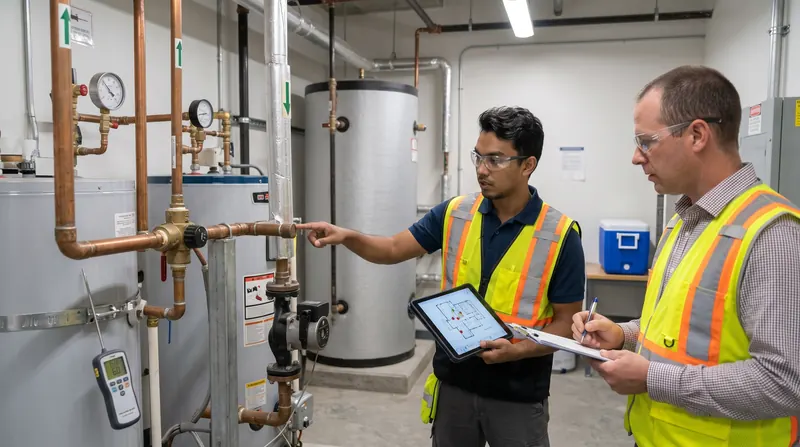
What Is a Water Safety Plan?
A Water Safety Plan (WSP) is a written, building-specific program that shows exactly how your water systems are managed to keep people safe. You may also see it called a Legionella management program, a water management program, or a Legionella control plan.
Your plan answers five questions:
What water systems does your building have? Incoming supply, hot and cold water, storage tanks, cooling towers, fountains, showers and more, shown on a clear diagram.
Where could bacteria grow or spread? Warm water, stagnant pipes ("dead legs"), unused fixtures and anything that creates mist or spray.
What keeps those risks under control? Temperatures, flushing, cleaning, disinfection and water treatment.
How do you know it's working? A testing schedule with clear action levels for Legionella, bacteria and metals.
What happens if a test fails? Step-by-step corrective actions, who does them, and how fast. It also sets out who on your team is responsible for each task, what training they need, and what records you keep, so you're ready for an inspection or an audit at any time.
A Water Safety Plan does two things at once. It keeps the people who live, work and visit your building from getting sick. It also keeps you from paying for emergency shutdowns, rushed disinfection, damaged equipment and liability claims after something goes wrong. Prevention costs far less than a response.
What Problem Does It Solve?
Legionella bacteria live naturally in lakes and rivers at low levels. The problem starts when they get into a building's water system and find the conditions they like: warm water, stagnant water, scale, sediment and biofilm.
When contaminated water turns into mist from a shower, faucet, cooling tower, hot tub or fountain, people can breathe it in. That can cause Legionnaires' disease, a serious form of pneumonia that can lead to hospitalization and death. People over 50, smokers, and anyone with a chronic illness or a weakened immune system are at the highest risk.
Most buildings never see the problem coming, because:
Routine maintenance protects equipment, not people. Water treatment vendors check pH, hardness and scale to protect pipes and boilers. That's not the same as testing for the bacteria that make people sick.
Risks change when your building changes. Hybrid work, vacant floors, seasonal shutdowns and renovations all leave water sitting still in the pipes. Stagnant water means more bacteria, weaker disinfectant and more lead leaching from plumbing.
Cooling towers can spread bacteria far beyond your property. Mist from a contaminated tower can travel several kilometres, so one tower can affect a whole neighbourhood.
Without a plan, every positive result becomes an emergency. Nobody knows what the number means, who should act, or how fast.
Why You Should Have a Water Safety Plan
Protect the people in your building
Tenants, residents, patients, students, guests and staff all depend on safe water. A plan finds the risks before anyone gets sick.
Avoid costly shutdowns and emergency repairs
If public health investigates a case linked to your building, they can tell you to shut down cooling towers, showers, fountains, ice machines or entire wings until the system is cleaned. A plan with pre-set action levels lets you fix problems early, on your schedule, before they get that far.
Protect your equipment
Emergency disinfection is harsh. Strong chemicals can corrode pipes, cause leaks and leach metals into your drinking water. Controlling bacteria routinely means fewer emergency treatments and less wear on your systems.
Test smarter, not more
A plan tells you exactly where and how often to test, so you aren't paying to sample the wrong places, or missing the right ones.
Show due diligence
Ontario employers must take every reasonable precaution to protect workers. When public health investigates a Legionella case, one of the first things they ask for is your water safety plan, building schematics and maintenance records. A current plan is your proof that you took the risk seriously.
Meet tenant, insurer and auditor expectations
Property managers, boards, lenders, insurers and accreditation bodies increasingly ask for documented water management. Your plan answers that request in one document.What Canadian Governments Say in 2025
Two government documents published in 2025 make the case clearly.
Ontario Ministry of Health — Legionella Investigation Reference Document (effective January 1, 2025)
Ontario's new guidance for public health units lists developing, implementing and continually reviewing a Water Safety Plan as a responsibility of building water system owners and operators. It describes a WSP as the core of long-term Legionella prevention, and it expects public health inspectors to review your plan during any investigation.
Government of Canada, National Joint Council — Legionella Communiqué 2025-1 (March 2025)
The federal Service-Wide Committee on Occupational Health and Safety reminded employers that they need a plan to control Legionella to protect workers and show due diligence under the Canada Labour Code. It recommends weekly dipslide tests, monthly Legionella culture tests and qPCR testing after cooling tower start-up. It also warns that changing occupancy from hybrid work can leave water stagnant, raising the risk of bacteria and lead in building water.
Every plan we write follows these documents and the standards they point to.Regulatory Alignment
Built to align with ASHRAE Standard 188, Public Works and Government Services Canada (PWGSC) MD 15161, Health Canada drinking water guidelines, and provincial Occupational Health and Safety (OHS) due diligence standards. Also aligned with the Ontario Ministry of Health's 2025 Legionella Investigation Reference Document and the National Joint Council's 2025 Legionella communiqué.
What’s Included in Your Customized Water Safety Plan
We handle the heavy lifting from initial site walk-through to ongoing verification:
- 01
Facility & Plumbing Risk Assessment
- On-site inspection of domestic hot and cold water systems, cooling towers, storage tanks, and low-flow fixtures. A written preliminary risk assessment of every Legionella-susceptible system in your building.
- Identification of stagnation zones ("dead legs"), temperature vulnerabilities, and aerosol-generating equipment.
- 02
Process Flow Diagrams
- Clear, visual schematics mapping water entry, treatment points, heating/cooling loops, and high-risk outlets across your building.
- 03
Control Measures & Monitoring Protocols
- Custom temperature, flushing, and disinfection thresholds tailored to your building’s occupancy and risk profile. Clear roles for your facility manager, building operators, housekeeping and contractors.
- Easy-to-follow logbooks and checklists for your on-site maintenance team.
- 04
Baseline & Recurring Laboratory Validation
- On-site sample collection by trained technicians for Legionella, microbiological indicators (E. coli / total coliforms), and heavy metals. Legionella culture and rapid qPCR testing, with action levels that tell you exactly what each result means.
- Plain-language lab reports with clear pass/fail benchmarks—no confusing scientific jargon.
- 05
Corrective Action & Emergency Response Plans
- Pre-written, step-by-step protocols detailing exactly what to do if a sample exceeds safe action limits, protecting you from liability and operational downtime. Staff training requirements and a recordkeeping schedule, so your plan stays audit-ready year after year
Who Needs a Water Safety Plan?
- Commercial & Residential Real Estate: Office towers · Condominiums · Apartment buildings · Mixed-use developments · Shopping centres and malls · Property management portfolios · Data centres
- Healthcare & Senior Living: Hospitals · Long-term care homes · Retirement residences · Medical and dental clinics · Rehabilitation centres · Laboratories
- Hospitality, Recreation & Fitness: Hotels and resorts · Spas, hot tubs and steam rooms · Fitness centres and gyms · Pools, water parks and aquatic centres · Restaurants and banquet halls · Arenas and stadiums
- Education & Childcare: Schools · Colleges and universities · Student residences · Daycares and childcare centres
- Manufacturing & Industrial: Manufacturing plants · Meat and poultry processing · Food and beverage processing · Breweries, wineries and dairies · Pharmaceutical and chemical plants · Automotive and metal fabrication · Plastics and rubber · Pulp and paper · Power genera
How It Works
- Step
On-Site Assessment & Baseline Sampling
Our technicians inspect your mechanical systems and collect baseline water samples across key control points.
- Step
Custom Plan Development
Within 1 - 2 weeks, we build your facility-specific Water Safety Plan, flow diagrams, and monitoring logs.
- Step
Team Walkthrough & Implementation
We review the plan with your facility staff so everyone knows their exact role.
- Step
Ongoing Verification
Scheduled quarterly or semi-annual lab testing ensures your control measures remain effective year-round.
Don't Wait for an Outbreak or Inspection to Find a Gap.
Protect your occupants, avoid costly shutdowns, and show clear due diligence with an independent Water Safety Plan built for your building.